TERIMA KASIH ATAS KUNJUNGAN ANDA.....

Minggu, 04 April 2010

DAUR ULANG LIMBAH MENJADI KOMPOS


Selama ini limbah hanya dipandang sebelah mata oleh masyarakat khususnya di Indonesia. Padahal dari berbagai macam limbah yang kita temui dapat dihasilkan produk olahan yang dapat memberi keuntungan maupun manfaat bagi pengelolanya, masyarakat juga lingkungan. Proses daur ulang sampah menjadi berbagai macam produk akan mengurangi dampak pencemaran lingkungan yang selama ini semakin mengkhawatirkan.
Salah satu cara yang dapat dilakukan dalam upaya pemanfaatan limbah adalah dengan mendaur ulangnya menjadi pupuk kompos. Sebelum kita mengetahui proses pembuatan pupuk kompos, perlu diketahui terlebih dahulu berbagai macam limbah yang dapat digunakan untuk pembuatannya. Limbah ini dibedakan menjadi 4 macam, yaitu :
  1. Limbah peternakan (padat, cair)
  2. Pertanian (Jerami, dll)
  3. Pekarangan (Dedaunan, dll)
  4. Rumah tangga (abu, sisa makanan, dll)
Dalam pembuatannya selain menggunakan bahan dari limbah, diperlukan juga bahan penunjang diantaranya : Mikroorganisme pengurai ( biolahang, EM4) , Molases (tetes), Serbuk gergajian, Abu, zeolit/kapur tohor, air. Selain itu, jika diperlukan untuk menambah efektifitas kompos ini, dapat juga ditambahkan dedaunan seperti lamtoro, kleresede, mindi, mimba, dsb.
Standar proses bahan campuran ini adalah 80 % pupuk kandang dan 20 % limbah pertanian, pekarangan, rumah tangga dan lainnya. Proses pembuatannya:
  1. Dibuat campuran pupuk kandang : limbah = 80 : 20 tadi kedalam wadah sampai menjadi satu adonan. (Nb : untuk 2 s/d 2 1/2 ton)
  2. Langkah berikutnyua ambil 1 liter larutan pengurai + 1 liter gula/ tetes + 200 - 300 liter air. Aduk hingga menjadi satu larutan.
  3. Campurkan larutan tadi dengan adonan yang telah dibuat. Perlu diketahui, selama proses pengomposan, kompos harus tertutup (tidak terkena sinar matahari maupun air hujan secara langsung.
Hasil pengomposan dilihat setelah 35 hari. Ciri bahwa kompos tersebut jadi adalah semua bahan terdekomposisi dengan baik dan merata dengan tekstur kompos menjadi remah. Demikian salah satu pemanfaatan limbah menjadi pupuk kompos, selain dapat meminimalisir dampak pencemaran lingkungan, hasil dari kompos ini sangat baik digunakan untuk pupuk yang dapat membantu pertumbuhan dan perkembangan tanaman yang kita budidayakan.


Jumat, 12 Februari 2010

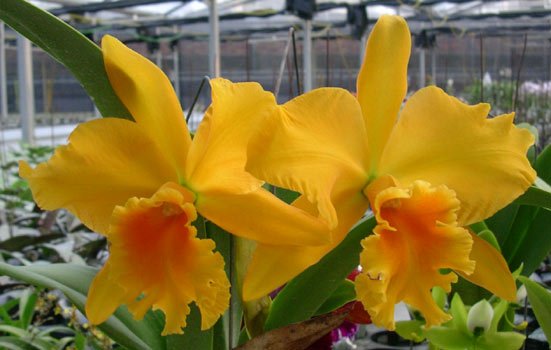
CATTLEYA THE QUEEN ORCHIDS


CATTLEYAS and LAELIAS These orchids are the most sumptuous and exotic of all and are chosen for corsages. In nature there are about 50 species each of Cattleya and of Laelia from Central America, growing through the Amazon region to the south of Brazil. Their distinctive flowers and the tendency of these plants to grow in large colonies has meant that they have been vigorously over-collected and the status of many is endangered.

The plants produce strong 'pseudobulbs' topped with one or more leathery leaves.
Each year a dormant bud at the base grows into a new shoot. This thickens to produce the current year's pseudobulb. The flowers arise from the axil of the current year's leaf where a protective sheath usually develops, and come in a range of colours from white and pink to green and purple, depending on the parentage and genera. Some flower twice yearly.

Hybrids.
Multitudes of hybrids have been bred over the years, many of which are easy to grow and easy to flower.

Over 40 other genera of orchid have been cross bred with Cattleyas and Laelias, and notably among them Sophronitis has been used to introduce scarlet and Brassovola for the frilly lip.

Temperature and Humidity.
Minimum night temperatures of 10 -15 C, depending on the plants' origin, are needed, but growth in summer is rapid at temperatures up to 26 C. A humid atmosphere, propelled by a fan is beneficial.

Light requirements.
For best results, the normal maximum is 50% of full daylight or 2000-3000 foot candles.
In hot weather shade sufficiently to ensure that the leaves are cool to the touch.
If you are growing in the home give a bright situation but not direct sunlight, behind a net curtain, from April to September.
These also make good conservatory plants as long as summer shade and good air movement can be provided.

Watering and Fertilising.
From March to September the compost should never be allowed to dry out completely.
Water twice weekly and fertilise fortnightly with a recommended orchid fertiliser.
From October to February, no fertiliser is needed, but water the plants when the compost appears dried out. It is better to underwater as the plants can stand neglect more than over watering!

Compost and potting.
A medium bark mix will do well with added polystyrene spheres or perlite to keep it open. Chopped sphagnum helps retain humidity and some charcoal keeps it 'sweet'. New compost will keep the plant growing for two to three years before it turns acid and the plant needs repotting. Don't repot until the plant roots are likely to go over the sides of the current pot and the best time to repot is when the new roots are just beginning to appear at the new shoot's base.
If the plant has over eight pseudobulbs, the thick rhizome can be cut to give two equal sized plants which can be potted separately.